What your live site actually does, checked after every deploy.
Below is a live scan of example.com so you can see what a report looks like. Enter your own URL above to run yours: ten seconds, no signup, and the whole report is free.
What the scores mean
3 findings stand between example.com and a Clean Bill of Health: No privacy policy found; No terms of service; No public contact or business identity. What the certificate is
Opportunities
These are the issues most likely to matter to a regulator, an app store, or an attacker. Fix them first.
No privacy policy found~20 min
No link or page matching a privacy policy was detected. Almost every jurisdiction that a site with users touches requires one if you collect any personal data, even an email or an analytics ID.
CalOPPA requires a policy for any site reaching Californians. GDPR Art. 13 and PIPEDA require disclosure of what you collect. Regulator-enforced.
# Privacy Policy

example.com is operated by **[Legal entity operating example.com]** ("we", "us", "our"), the data controller
for the personal information described here. This policy explains what we
collect, how we use it, who we share it with, and your rights.

_Last updated: November 22, 2026_

## Information we collect

- **Information you give us.** When you contact us, we collect what you provide, such as your name and email address.
- **Usage data.** Our servers record basic technical information such as your IP address, browser type and the pages requested, to keep the site working and secure.
- **Cookies.** See "Cookies" below.

## How we use your information

- To provide, maintain, and improve the Service.
- To respond to your requests and communicate with you.
- To monitor usage and detect, prevent, and address technical issues and abuse.
- To comply with legal obligations.

## Legal bases (EEA/UK users)

Where the GDPR/UK GDPR applies, we rely on: performance of a contract with you
(providing the Service), your consent (marketing email; you may withdraw it at any time), our legitimate interests in
operating and securing the Service, and compliance with legal obligations.

## Who we share it with

We do not sell your personal information. We share it with the providers below,
who process it on our behalf under their own data-processing terms, and where
the law requires.

Hosting and email providers who run the service for us, under their own data-processing terms.

## Sale of personal information

We do not sell personal information, and we do not share it for cross-context behavioural advertising.

## International transfers

Our hosting provider may store information outside your country. Where information about people in the EEA or UK is transferred outside the EEA or UK, we rely on Standard Contractual Clauses or an adequacy decision.

## Data retention

Account and contact information: for as long as you use the Service, then up to
[12 months] unless the law requires longer.
Usage and analytics data: [up to 12 months]. Server logs: [30 days]. (Bracketed periods are typical defaults; set them to what you actually do.)

## Your rights

**California residents:** You have the right to know what personal information we
collect, to request deletion, to correct it, and to opt out of any sale or sharing
of personal information (we do not sell it). **EEA/UK residents:** You have the right to access, correct, delete, restrict,
or port your data, and to object to processing. To exercise any right, email [[email protected]]. We answer within [30] days.

## Complaints

If you are unhappy with how we handle your information, tell us first at [[email protected]]. You may also lodge a complaint with your data-protection authority (in the UK, the ICO; in the EEA, the supervisory authority of your country).

## Cookies

We use only the cookies needed to run the site. You can block cookies in your browser; the site will still work.

## Children

The Service is not directed to children under 13 (or the minimum age in your
country), and we do not knowingly collect their data. If you believe a child has
provided us information, contact us and we will delete it.

## Security

We protect your information with access controls, encryption in transit. No method is perfect; if we learn of a breach affecting you we will notify you as the law requires.

## Changes

We may update this policy. Material changes will be posted here with a new date.

## Contact

[Legal entity operating example.com]
Email: [[email protected]]
Postal address: [your registered address]

---
_This document was generated from what the scanner observed on example.com on
November 22, 2026: no third-party services detected. It is a starting point, not legal advice. Confirm it matches what you actually run, fill in the bracketed details, and have counsel review it if you handle health, financial, or children's data._Diagnostics
Worth fixing. Not an emergency.
No terms of service~15 min
No terms of service or terms of use page was detected. Not legally mandated everywhere, but without one you have no liability limits, no governing law, and no acceptable-use rules.
# Terms of Service

_Last updated: November 22, 2026_

Welcome to example.com, operated by [Legal entity operating example.com] ("we", "us"). By using example.com (the
"Service") you agree to these Terms. If you do not agree, do not use the Service.

## 1. Use of the Service
You must be at least 13 years old (or the minimum age in your country). You agree
to use the Service lawfully and not to misuse, disrupt, or reverse-engineer it.

## 2. Accounts
If you create an account, you are responsible for keeping your credentials secure
and for activity under your account.

## 3. Content and intellectual property
The Service and its content are owned by us or our licensors. You retain rights to
content you submit, and grant us a licence to host and display it to operate the
Service.

## 4. Payment
Where the Service is paid, fees, billing cycles, and refund terms are as described
at purchase.

## 5. Disclaimers
The Service is provided "as is" without warranties of any kind, to the fullest
extent permitted by law.

## 6. Limitation of liability
To the maximum extent permitted by law, we are not liable for indirect,
incidental, or consequential damages arising from your use of the Service.

## 7. Termination
We may suspend or terminate access if you breach these Terms.

## 8. Governing law
These Terms are governed by the laws of [the State of Delaware, USA: change to where the company is registered], without regard to conflict-of-law
rules.

## 9. Changes
We may update these Terms. Continued use after changes means you accept them.

## 10. Contact
Questions? Email [[email protected]].

---
_Template only, not legal advice. Have counsel review before publishing._No public contact or business identity~5 min
No contact email or contact page was detected. GDPR requires a way for users to reach the data controller. App stores and payment processors require it too.
Missing 4 security headers~15 min
Not set: Content-Security-Policy, Strict-Transport-Security, X-Content-Type-Options, X-Frame-Options. These defend against clickjacking, MIME sniffing, and protocol downgrade.
# Missing on your site: Content-Security-Policy, Strict-Transport-Security, X-Content-Type-Options, X-Frame-Options. The Content-Security-Policy below already allows only your own origin; add the domain of anything else you load to script-src or connect-src, then re-scan.
/*
  Strict-Transport-Security: max-age=63072000; includeSubDomains; preload
  X-Content-Type-Options: nosniff
  X-Frame-Options: SAMEORIGIN
  Referrer-Policy: strict-origin-when-cross-origin
  Permissions-Policy: camera=(), microphone=(), geolocation=()
  Content-Security-Policy: default-src 'self'; script-src 'self'; connect-src 'self'; img-src 'self' data: https:; style-src 'self' 'unsafe-inline'; font-src 'self' data:; frame-src 'none'; frame-ancestors 'self'; base-uri 'self'; form-action 'self'
No legal entity name or address~5 min
Sites that take money or serve EU/German users are expected to show who runs them and where. It also unblocks Stripe and app-store reviews.
GDPR Art. 13(1)(a) (controller identity); German TMG §5 Impressum; EU e-Commerce Directive Art. 5; consumer-protection rules in most countries.
No security.txt for vulnerability reports~5 min
A /.well-known/security.txt file tells researchers how to report a problem before it becomes a breach. Two lines: Contact and Expires.
RFC 9116; expected by many bug-bounty and disclosure norms.
What these findings expose you to
For scale: the privacy items fall under GDPR's top tier (up to 4% of turnover; small-business fines for missing notices and cookie consent have run from the low thousands of euros upward) and, for California users, CalOPPA at up to $2,500 per violation and CCPA at roughly $2,500 to $7,500 per violation once you pass its thresholds; the security items sit under GDPR Art. 32 (up to 2% of turnover) and the FTC's security enforcement, where the real cost arrives with a breach and its mandatory notifications. In practice the first step is almost always a complaint and a notice with a deadline; the cost comes from ignoring it. These are published maximums and reported ranges, not a prediction.
GDPR / UK GDPR, transparency and consent · EU, EEA, UK3 findings
Maximum. Up to €20 million or 4% of worldwide annual turnover, whichever is higher (Art. 83(5)); UK: up to £17.5 million or 4%.
Usually. A complaint to a data-protection authority, then a notice with a deadline to fix. Published fines against small businesses for missing notices and cookie consent have run from the low thousands of euros upward; the largest cookie-consent fines have been in the tens of millions.
Applies: Any site with users in the EU or UK, regardless of where the company is. Enforced by regulators.
GDPR / UK GDPR, security of processing · EU, EEA, UK1 finding
Maximum. Up to €10 million or 2% of worldwide annual turnover (Art. 83(4)); UK: up to £8.7 million or 2%.
Usually. Fines follow a breach, not a scan. If exposed data reaches users, breach notification to the regulator within 72 hours is mandatory and the fine considers whether the weakness was known.
Applies: Any site processing personal data of people in the EU or UK. Enforced by regulators.
CCPA / CPRA (California) · United States, California1 finding
Maximum. About $2,500 per violation and about $7,500 per intentional violation or one involving a minor, inflation-adjusted each year; each affected consumer can count as a violation.
Usually. A notice from the California Privacy Protection Agency or Attorney General; the 30-day cure period was removed in 2023. Enforcement has focused on larger companies, but the thresholds catch many startups once they pass roughly $26 million in revenue or 100,000 consumers.
Applies: Businesses over the CCPA thresholds with California users. Many early-stage sites are below them; the privacy-policy duty under CalOPPA applies to all. Enforced by regulators.
CalOPPA (California Online Privacy Protection Act) · United States, California1 finding
Maximum. Up to $2,500 per violation, enforced through California's unfair-competition law after a 30-day notice.
Usually. A notice to post a compliant policy within 30 days. Applies to any commercial site reaching Californians, with no size threshold.
Applies: Any commercial site or app collecting personal information from California residents. Enforced by regulators.
PIPEDA / Quebec Law 25 · Canada2 findings
Maximum. Quebec Law 25: administrative penalties up to CA$10 million or 2% of worldwide turnover, and penal fines up to CA$25 million or 4%. PIPEDA itself currently relies on findings and court orders.
Usually. A complaint to the Privacy Commissioner or Quebec's CAI, an investigation, and a public finding; Quebec has begun issuing monetary penalties.
Applies: Any organisation collecting personal information from people in Canada; Law 25 for Quebec residents. Enforced by regulators.
FTC Act §5 (unfair or deceptive practices) and state breach laws · United States1 finding
Maximum. No fixed fine for a first violation; the FTC obtains consent orders with 20-year audit obligations, and violating an order costs over $53,000 per day. State breach-notification laws add per-resident notification costs and, in some states, per-record penalties.
Usually. Enforcement follows an incident. An exposed live key or open database is the incident waiting to happen; the practical cost is fraud on the account plus mandatory notification.
Applies: Any US company holding consumer data. Enforced by regulators.
AI design tells
No generated-design patterns detected on this page.
Full annotated page (0 labels)
This report is complete and free, and true as of the scan time above. The next deploy, a tag added in Tag Manager or a redesigned footer can change it. Watch re-checks example.com every day and after every deploy, emails you the moment something regresses, keeps the dated record, and gives you a trust page your customers can check.
Watch example.comTrust page draftPassed audits
(5)
No third-party trackers detected
None of the common analytics or marketing pixels were found in the page.
No secret keys in the page or its scripts
No server-side keys (Stripe secret, OpenAI, Anthropic, AWS, GitHub, Slack, SendGrid, Supabase service_role, private keys) in the page.
No mixed content
All referenced resources use HTTPS.
Served over HTTPS
The final URL uses TLS.
No WCAG A/AA violations found (10 rules passed)
axe-core found no violations of the WCAG 2.2 A/AA rules it can test automatically. Automated checks cover roughly a third of WCAG; manual review is still needed for the rest.
An assistant can read your code. It cannot watch your site.
Ask an AI to audit your app and it reads the repository. Regulators, plaintiffs' scanners and careful customers never see the repository. They load the live site, and the live site is the build plus everything added since: the tag a marketer put in Tag Manager, the chat widget, the CMS embed, the redesign that dropped the privacy link. Webopsy loads it in a real browser and records what actually happens. The report and every fix are free. What we charge for is doing it again after every deploy, and keeping the record.
Evidence, not a checklist.
Each tracker finding says what the browser saw and when, for example: Meta Pixel sent data 0.8 seconds after load, to facebook.com, before anyone answered a banner. Session recorders are called out separately, because recording visitors before consent is what US wiretap claims are built on. None of it is visible in your code if the tag arrives through a tag manager.
Your policy, against your site.
A privacy policy can be complete on paper and still not describe the site. The scan compares what your policy says with what the browser saw: ad pixels while the policy never mentions advertising, a session recorder while it never mentions recording. Then it writes the policy that matches, and the banner that holds those tags until a visitor agrees.
Watched after every deploy.
Watch re-checks the site every day and within a minute of every deploy, through a deploy hook or a GitHub Action that fails the job when something regressed (the Action alone is free). You get an email, a dated record of every check, and a trust page that answers the questions vendor reviews ask, from live evidence. The Clean Bill of Health stays in force while the site deserves it.
The report and every fix: free. Watch: $19 a month per site. Or a person implements every fix for $499, or audits the backend for $1,500. Pricing
What each score covers.
- Privacy
- Privacy policy present and complete (the fourteen disclosures GDPR, CCPA and PIPEDA expect), cookie consent before trackers fire, cookie policy, Do-Not-Sell link, children's data, newsletter consent.
- Security
- HTTPS and mixed content, the security headers, secret keys shipped in the bundle, Supabase and Firebase left open, a security.txt so researchers can reach you.
- Legal
- Terms of service, a way to contact you, and the legal identity and address that Stripe, the app stores and EU law expect to see.
- Accessibility and design
- WCAG 2.2 A/AA violations from axe-core, run on the live page in a real browser. And the detector for the patterns visitors read as AI-generated, each one marked on a screenshot of your page.
When something cannot be verified from outside, the report says so instead of guessing. What is and is not checked.
What the report contains.
A document you can hand to a developer, a co-founder or counsel. Pages below are from the example.com report above; with Watch it also comes as a PDF.
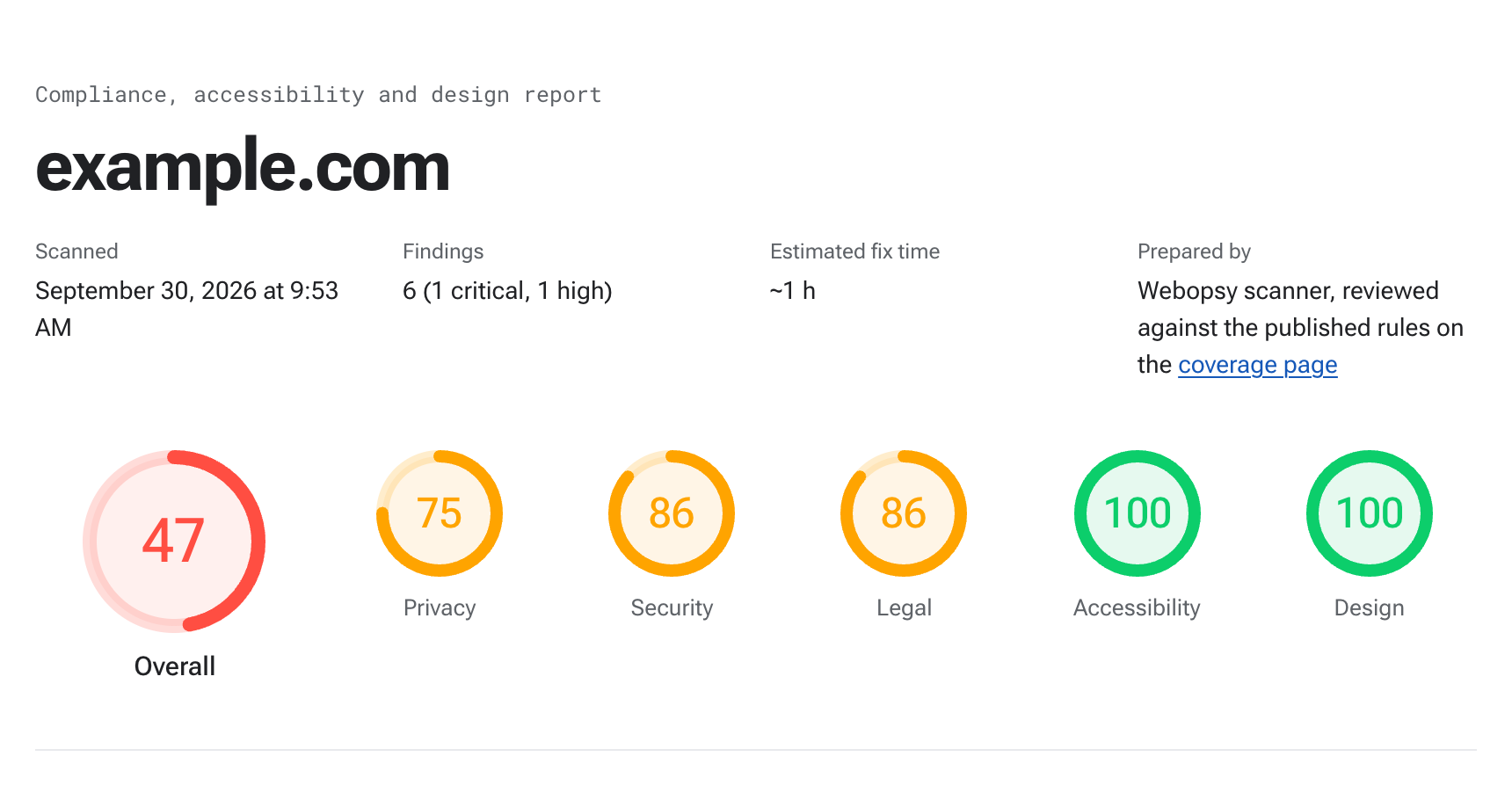 Cover. Six scores, findings count, total fix time.
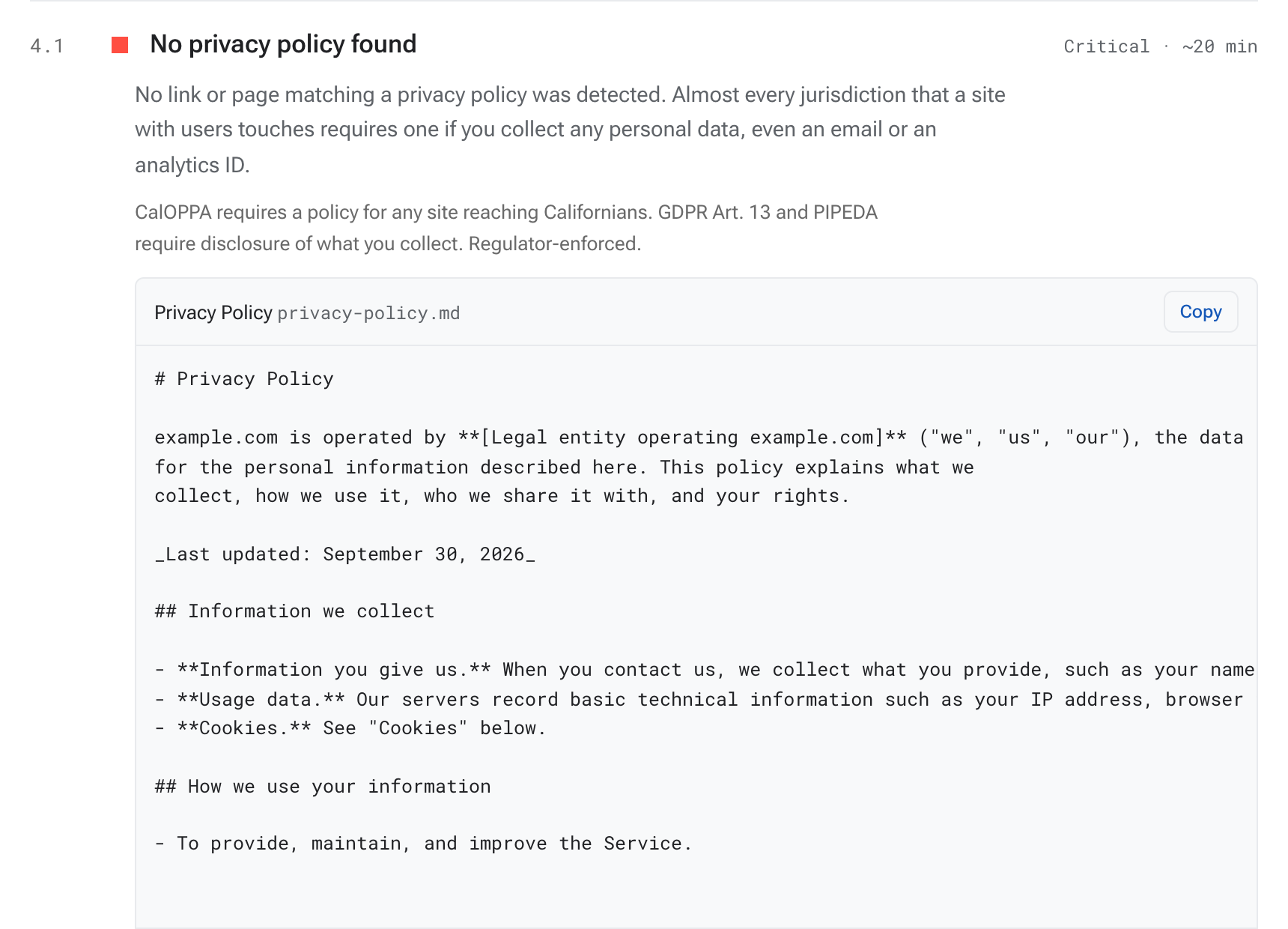 Every finding with the law it maps to and the fix, inline.
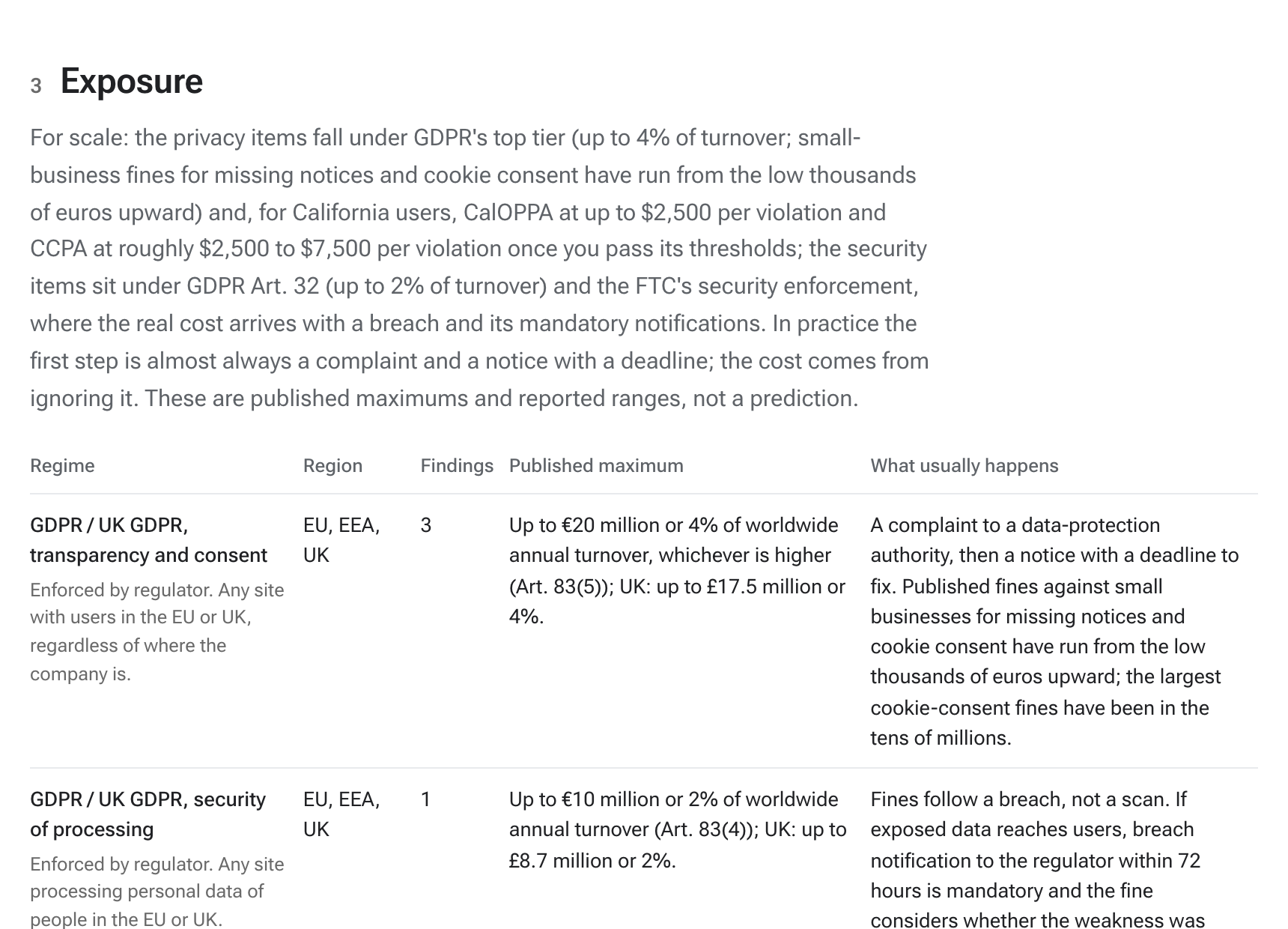 Statutory exposure per regime. Published maximums, and what usually happens in practice.
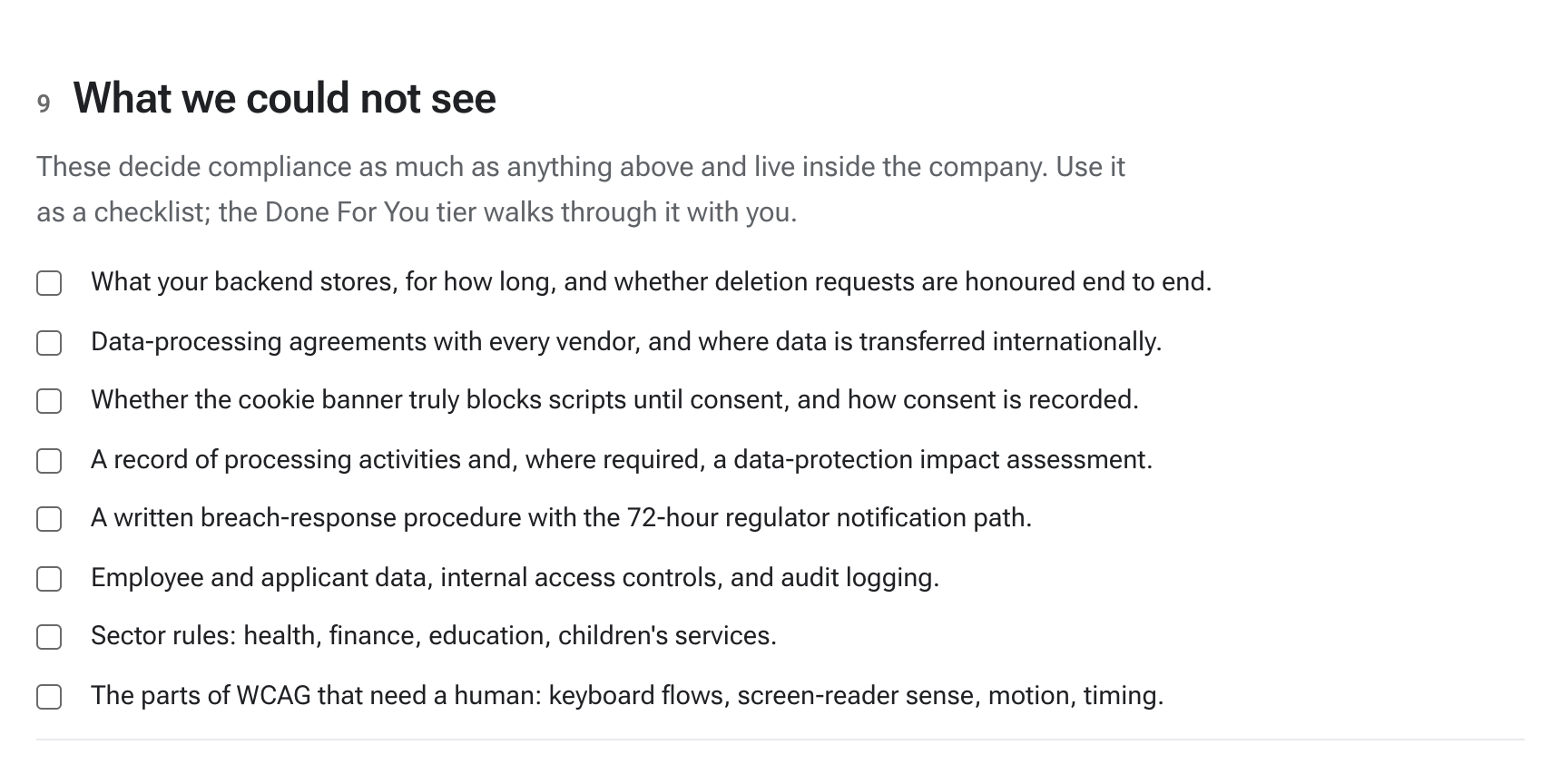 What no outside scan can see, so nobody mistakes a clean score for a guarantee.