This report was prepared for agentmingo.com. It shows the top findings; the full report includes every issue and its fix.
What the scores mean
No change since the scan on Nov 15, 2026.
Clean bill of health since Oct 31, 2026, serial WO-2026-3454. View the certificate
Opportunities
No critical or high-severity issues. That's the bar most sites miss.
Diagnostics
Worth fixing. Not an emergency.
No legal entity name or address~5 min
Sites that take money or serve EU/German users are expected to show who runs them and where. It also unblocks Stripe and app-store reviews.
GDPR Art. 13(1)(a) (controller identity); German TMG §5 Impressum; EU e-Commerce Directive Art. 5; consumer-protection rules in most countries.
What these findings expose you to
For scale: the privacy items fall under GDPR's top tier (up to 4% of turnover; small-business fines for missing notices and cookie consent have run from the low thousands of euros upward) and, for California users, CalOPPA at up to $2,500 per violation and CCPA at roughly $2,500 to $7,500 per violation once you pass its thresholds. In practice the first step is almost always a complaint and a notice with a deadline; the cost comes from ignoring it. These are published maximums and reported ranges, not a prediction.
GDPR / UK GDPR, transparency and consent · EU, EEA, UK1 finding
Maximum. Up to €20 million or 4% of worldwide annual turnover, whichever is higher (Art. 83(5)); UK: up to £17.5 million or 4%.
Usually. A complaint to a data-protection authority, then a notice with a deadline to fix. Published fines against small businesses for missing notices and cookie consent have run from the low thousands of euros upward; the largest cookie-consent fines have been in the tens of millions.
Applies: Any site with users in the EU or UK, regardless of where the company is. Enforced by regulators.
AI design tells
52 patterns on this page read as AI-generated: Nested cards, Hairline border with wide shadow, Kicker / eyebrow label above heading. Visitors have learned to recognize these; they read as a template and cost trust. Each one has a specific fix.
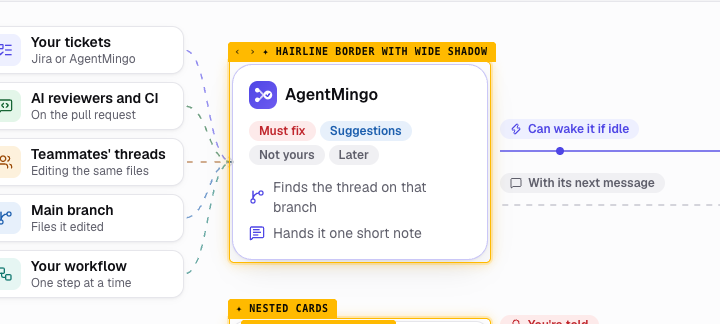
Nested cards23×
Cards inside cards create visual noise and excessive depth. Flatten the hierarchy — use spacing, typography, and dividers instead of nesting containers.
Example: Card inside card
Hairline border with wide shadow10×
A hairline border paired with a wide, diffuse shadow is a recurring generated-UI signature. Commit to one — a defined edge or a soft elevation — rather than both at once.
Example: 1px border + 32px shadow blur
Kicker / eyebrow label above heading6×
A tiny tracked uppercase or small-caps label sitting as its own block directly above a heading is banned outright, repeated or not. Generated kickers never earn their place: the heading carries its own weight. Delete the label and let the heading speak; if the words matter, work them into the heading or the body.
Example: kicker "The context layer" above h2 "What reaches your agent's thread"
AI color palette4×
Purple/violet gradients and cyan-on-dark are the most recognizable tells of AI-generated UIs. Choose a distinctive, intentional palette.
Example: Purple/violet gradient background
Bounce or elastic easing4×
Bounce and elastic easing feel dated and tacky. Real objects decelerate smoothly — use exponential easing (ease-out-quart/quint/expo) instead.
Example: cubic-bezier(0.2, 0.9, 0.3, 1.3)
Gradient text2×
Gradient text is decorative rather than meaningful — a common AI tell, especially on headings and metrics. Use solid colors for text.
Example: background-clip: text + gradient
Overused font1×
Inter, Roboto, Fraunces, Geist, Plus Jakarta Sans, and Space Grotesk are used on so many sites they no longer feel distinctive. Each new wave of AI-generated UIs converges on the same handful of faces. Choose a face that gives your interface personality.
Example: Primary font: geist (97% of text)
Auto-scrolling marquee1×
Continuously auto-scrolling content demands attention it has not earned and hides half its content at any moment. Reserve motion for content that changes; let readers move at their own pace.
Example: .am-marquee — infinite horizontal loop animation "am-marquee"
Repeating-gradient stripes1×
Repeating-gradient stripes used as surface decoration are a recurring generated-UI signature. Reach for a deliberate texture or leave the surface plain.
Example: repeating-gradient decorative stripes
Line length too long · quality12×
Text lines wider than ~80 characters are hard to read. The eye loses its place tracking back to the start of the next line. Add a max-width (65ch to 75ch) to text containers.
Example: ~97 chars/line (aim for <80)
Content overflowing its container · quality5×
Content renders wider than its container, spilling out or forcing a horizontal scrollbar. Let text wrap, constrain widths, or give the region a deliberate scroll affordance.
Example: li overflows its box by 396px
Low contrast text · quality4×
Text does not meet WCAG AA contrast requirements (4.5:1 for body, 3:1 for large text). Increase the contrast between text and background.
Example: 3.4:1 (need 4.5:1) — text #ffffff on #ea3ede
All-caps body text · quality2×
Long passages in uppercase are hard to read. We recognize words by shape (ascenders and descenders), which all-caps removes. Reserve uppercase for short labels and headings.
Example: text-transform: uppercase on 39 chars of body text
Cramped padding · quality2×
Text is too close to the edge of its container. Two shapes: (1) an element with its own text where the padding is too low for the font size, and (2) a wrapper with text-bearing children and near-zero padding against a visible boundary (border, outline, or non-transparent background) — children land flush against the boundary line. Add at least 8px (ideally 12–16px) of padding inside bordered, outlined, or colored containers.
Example: <span> "inline-flex": children flush against bg on top/bottom (no inset)
Full annotated page (77 labels)

This report is complete and free, and true as of the scan time above. The next deploy, a tag added in Tag Manager or a redesigned footer can change it. Watch re-checks agentmingo.com every day and after every deploy, emails you the moment something regresses, keeps the dated record, and gives you a trust page your customers can check.
Watch agentmingo.comTrust page draftPassed audits
(11)
Privacy policy is present
A privacy policy link or page was found.
Privacy policy covers the expected disclosures
6981 words; 14 disclosure checks passed; last updated November 10, 2026.
No third-party trackers detected
None of the common analytics or marketing pixels were found in the page.
Terms of service are present
A terms page or link was found.
Public contact or business identity present
A contact email, contact page, or mailto link was found.
No secret keys in the page or its scripts
No server-side keys (Stripe secret, OpenAI, Anthropic, AWS, GitHub, Slack, SendGrid, Supabase service_role, private keys) in the page or the 6 script bundles it loads.
4 security headers set
Content-Security-Policy, Strict-Transport-Security, X-Content-Type-Options, X-Frame-Options
No mixed content
All referenced resources use HTTPS.
security.txt published
Researchers know where to report a vulnerability.
Served over HTTPS
The final URL uses TLS.
No WCAG A/AA violations found (32 rules passed)
axe-core found no violations of the WCAG 2.2 A/AA rules it can test automatically. Automated checks cover roughly a third of WCAG; manual review is still needed for the rest.
Share this report.
The link is public and shows the same free view you see here; nothing about the reader is recorded.
The certificate.
agentmingo.com holds Clean Bill of Health WO-2026-3454, last checked November 22, 2026. Open it for the seal and what it verified.
Put your score on your README.
An embeddable badge that re-checks weekly. Builders use it the way they use a CI badge: proof the boring stuff is handled.
[](https://webopsy.tech/s/agentmingo.com)