This report was prepared for opuscule.app. It shows the top findings; the full report includes every issue and its fix.
What the scores mean
No change since the scan on Nov 15, 2026.
Clean bill of health since Oct 3, 2026, serial WO-2026-0445. View the certificate
Opportunities
These are the issues most likely to matter to a regulator, an app store, or an attacker. Fix them first.
Elements must meet minimum color contrast ratio thresholds (19 elements)~2 h
Ensure the contrast between foreground and background colors meets WCAG 2 AA minimum contrast ratio thresholds Example: <a href="/claude-code/#plugin">Claude Code</a>
WCAG wcag2aa, wcag143. Web accessibility is enforced under the ADA (US, thousands of private suits a year), Section 508, the European Accessibility Act, the UK Equality Act, and AODA (Ontario).
Links must be distinguishable without relying on color (3 elements)~20 min
Ensure links are distinguished from surrounding text in a way that does not rely on color Example: <a href="/claude-code/#plugin">Claude Code</a>
WCAG wcag2a, wcag141. Web accessibility is enforced under the ADA (US, thousands of private suits a year), Section 508, the European Accessibility Act, the UK Equality Act, and AODA (Ontario).
Diagnostics
Worth fixing. Not an emergency.
Missing 3 security headers~15 min
Not set: Content-Security-Policy, X-Content-Type-Options, X-Frame-Options. These defend against clickjacking, MIME sniffing, and protocol downgrade.
{
  "headers": [
    {
      "source": "/(.*)",
      "headers": [
        {
          "key": "Strict-Transport-Security",
          "value": "max-age=63072000; includeSubDomains; preload"
        },
        {
          "key": "X-Content-Type-Options",
          "value": "nosniff"
        },
        {
          "key": "X-Frame-Options",
          "value": "SAMEORIGIN"
        },
        {
          "key": "Referrer-Policy",
          "value": "strict-origin-when-cross-origin"
        },
        {
          "key": "Permissions-Policy",
          "value": "camera=(), microphone=(), geolocation=()"
        },
        {
          "key": "Content-Security-Policy",
          "value": "default-src 'self'; script-src 'self' 'unsafe-inline'; connect-src 'self'; img-src 'self' data: https:; style-src 'self' 'unsafe-inline'; font-src 'self' data:; frame-src 'none'; frame-ancestors 'self'; base-uri 'self'; form-action 'self'"
        }
      ]
    }
  ]
}Email signup with no consent or privacy notice~10 min
1 email field found and no consent, privacy, or unsubscribe wording anywhere on the page. Marketing email needs express consent in Canada and the EU.
CASL s. 6 (Canada); GDPR Art. 6–7 and PECR reg. 22 (EU/UK); CAN-SPAM (US, opt-out); Australia Spam Act.
No legal entity name or address~5 min
Sites that take money or serve EU/German users are expected to show who runs them and where. It also unblocks Stripe and app-store reviews.
GDPR Art. 13(1)(a) (controller identity); German TMG §5 Impressum; EU e-Commerce Directive Art. 5; consumer-protection rules in most countries.
No security.txt for vulnerability reports~5 min
A /.well-known/security.txt file tells researchers how to report a problem before it becomes a breach. Two lines: Contact and Expires.
RFC 9116; expected by many bug-bounty and disclosure norms.
What these findings expose you to
For scale: the privacy items fall under GDPR's top tier (up to 4% of turnover; small-business fines for missing notices and cookie consent have run from the low thousands of euros upward) and, for California users, CalOPPA at up to $2,500 per violation and CCPA at roughly $2,500 to $7,500 per violation once you pass its thresholds; the security items sit under GDPR Art. 32 (up to 2% of turnover) and the FTC's security enforcement, where the real cost arrives with a breach and its mandatory notifications; email capture without consent is a CASL exposure of up to CA$10 million per violation in Canada; the accessibility violations are the kind that draw private ADA suits, thousands a year, usually settled for $5,000 to $25,000 plus the plaintiff's fees. In practice the first step is almost always a complaint and a notice with a deadline; the cost comes from ignoring it. These are published maximums and reported ranges, not a prediction.
GDPR / UK GDPR, transparency and consent · EU, EEA, UK2 findings
Maximum. Up to €20 million or 4% of worldwide annual turnover, whichever is higher (Art. 83(5)); UK: up to £17.5 million or 4%.
Usually. A complaint to a data-protection authority, then a notice with a deadline to fix. Published fines against small businesses for missing notices and cookie consent have run from the low thousands of euros upward; the largest cookie-consent fines have been in the tens of millions.
Applies: Any site with users in the EU or UK, regardless of where the company is. Enforced by regulators.
GDPR / UK GDPR, security of processing · EU, EEA, UK1 finding
Maximum. Up to €10 million or 2% of worldwide annual turnover (Art. 83(4)); UK: up to £8.7 million or 2%.
Usually. Fines follow a breach, not a scan. If exposed data reaches users, breach notification to the regulator within 72 hours is mandatory and the fine considers whether the weakness was known.
Applies: Any site processing personal data of people in the EU or UK. Enforced by regulators.
ePrivacy Directive (EU) / PECR (UK), cookies and marketing · EU, UK1 finding
Maximum. Set nationally in the EU; the UK ICO can fine up to £500,000 under PECR.
Usually. Regulators run periodic sweeps of cookie banners; a warning letter is the common first step, with fines reserved for repeat or large-scale cases.
Applies: Sites setting non-essential cookies or sending marketing email to people in the EU or UK. Enforced by regulators.
CAN-SPAM (US) / CASL (Canada) · United States, Canada1 finding
Maximum. CAN-SPAM: over $53,000 per non-compliant email. CASL: up to CA$10 million per violation for a business.
Usually. CASL enforcement has produced six- and seven-figure penalties against companies that emailed without consent; CAN-SPAM actions target bulk senders. Collecting consent at signup is the fix.
Applies: Any marketing email to people in the US or Canada. Enforced by regulators.
ADA Title III and California's Unruh Act (web accessibility) · United States2 findings
Maximum. The ADA carries no fixed fine for private suits, but the defendant typically pays the plaintiff's attorney fees; California's Unruh Act adds statutory damages of $4,000 per violation. DOJ actions can carry civil penalties up to $75,000 for a first violation.
Usually. Thousands of private lawsuits a year, most against small and mid-sized sites, usually settled for roughly $5,000 to $25,000 plus fees. Fixing the automated violations is the cheapest defence.
Applies: Any business website in the US; California residents can sue under Unruh. Enforced by regulators and private plaintiffs.
European Accessibility Act / UK Equality Act / AODA · EU, UK, Ontario2 findings
Maximum. Set by each EU member state since June 2025; AODA penalties up to CA$100,000 per day for corporations; UK Equality Act claims are private.
Usually. Complaints and compliance orders first; fines are reserved for refusal to fix.
Applies: Consumer-facing digital services in the EU; Ontario organisations; UK service providers. Enforced by regulators and private plaintiffs.
FTC Act §5 (unfair or deceptive practices) and state breach laws · United States1 finding
Maximum. No fixed fine for a first violation; the FTC obtains consent orders with 20-year audit obligations, and violating an order costs over $53,000 per day. State breach-notification laws add per-resident notification costs and, in some states, per-record penalties.
Usually. Enforcement follows an incident. An exposed live key or open database is the incident waiting to happen; the practical cost is fraud on the account plus mandatory notification.
Applies: Any US company holding consumer data. Enforced by regulators.
AI design tells
2 patterns on this page read as AI-generated: Nested cards. Visitors have learned to recognize these; they read as a template and cost trust. Each one has a specific fix.
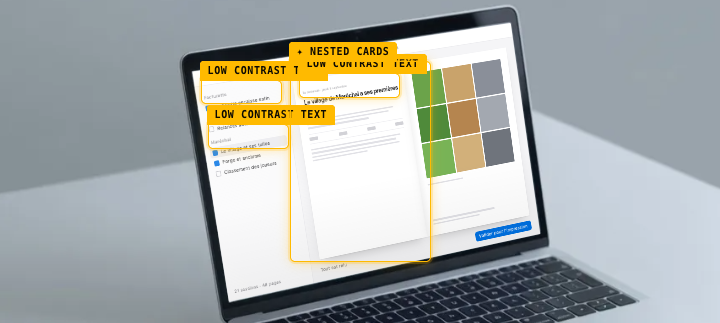
Nested cards2×
Cards inside cards create visual noise and excessive depth. Flatten the hierarchy — use spacing, typography, and dividers instead of nesting containers.
Example: Card inside card
Undersized functional text · quality133×
Interactive and content-bearing UI text (links, buttons, nav items, labels, table cells, meta rows, timecodes) below 11px is a legibility failure, not a style choice. WCAG sets no absolute pixel floor, but functional text under 11px is a defensible quality bar: it fails on high-DPI and small viewports and it degrades tap and read targets. The 11px floor holds even inside a footer; only non-interactive legal smallprint gets the softer 10px floor. Being ON the DESIGN.md size ramp does not exempt a value here: adding 8px to the ramp launders the token but not the legibility problem, and that is exactly the escape hatch this rule closes. Exempts sup/sub, visually-hidden (sr-only) text, and code/terminal contexts. Decorative letterspaced micro-labels are still functional and stay in scope.
Example: 8.5px functional text "Facturette" (below 11px floor)
Tiny body text · quality51×
Body text below 12px is hard to read, especially on high-DPI screens. Use at least 14px for body content, 16px is ideal.
Example: 8.5px body text
Low contrast text · quality12×
Text does not meet WCAG AA contrast requirements (4.5:1 for body, 3:1 for large text). Increase the contrast between text and background.
Example: 3.1:1 (need 4.5:1) — text #8e8e93 on #fafafb
Line length too long · quality3×
Text lines wider than ~80 characters are hard to read. The eye loses its place tracking back to the start of the next line. Add a max-width (65ch to 75ch) to text containers.
Example: ~182 chars/line (aim for <80)
Cramped padding · quality2×
Text is too close to the edge of its container. Two shapes: (1) an element with its own text where the padding is too low for the font size, and (2) a wrapper with text-bearing children and near-zero padding against a visible boundary (border, outline, or non-transparent background) — children land flush against the boundary line. Add at least 8px (ideally 12–16px) of padding inside bordered, outlined, or colored containers.
Example: <div> "seg": children flush against bg on top/bottom (no inset)
Skipped heading level · quality1×
Heading levels should not skip (e.g. h1 then h3 with no h2). Screen readers use heading hierarchy for navigation. Skipping levels breaks the document outline.
Example: <h1> "Le seul contexte qui ne sera jamais compacté." followed by <h3> "Facturette encaisse son premier abonnement" (missing h2)
Full annotated page (204 labels)

This report is complete and free, and true as of the scan time above. The next deploy, a tag added in Tag Manager or a redesigned footer can change it. Watch re-checks opuscule.app every day and after every deploy, emails you the moment something regresses, keeps the dated record, and gives you a trust page your customers can check.
Watch opuscule.appTrust page draftPassed audits
(10)
Privacy policy is present
A privacy policy link or page was found.
Privacy policy is written in another language
989 words at https://opuscule.app/confidentialite/. The disclosure checks only read English, so its completeness was not assessed.
No third-party trackers detected
None of the common analytics or marketing pixels were found in the page.
Terms of service are present
A terms page or link was found.
Public contact or business identity present
A contact email, contact page, or mailto link was found.
No secret keys in the page or its scripts
No server-side keys (Stripe secret, OpenAI, Anthropic, AWS, GitHub, Slack, SendGrid, Supabase service_role, private keys) in the page or the 3 script bundles it loads.
1 security header set
Strict-Transport-Security
No mixed content
All referenced resources use HTTPS.
Served over HTTPS
The final URL uses TLS.
35 accessibility rules passed
Rules axe-core tested and found no violations for.
Share this report.
The link is public and shows the same free view you see here; nothing about the reader is recorded.
The certificate.
opuscule.app holds Clean Bill of Health WO-2026-0445, last checked November 22, 2026. Open it for the seal and what it verified.
Put your score on your README.
An embeddable badge that re-checks weekly. Builders use it the way they use a CI badge: proof the boring stuff is handled.
[](https://webopsy.tech/s/opuscule.app)