This report was prepared for orcylo.app. It shows the top findings; the full report includes every issue and its fix.
What the scores mean
Score 90 since Nov 15, 2026 (90 → 90). Fixed: Elements must meet minimum color contrast ratio thresholds.
Clean bill of health since Oct 5, 2026, serial WO-2026-0905. View the certificate
Opportunities
These are the issues most likely to matter to a regulator, an app store, or an attacker. Fix them first.
All touch targets must be 24px large, or leave sufficient space (4 elements)~20 min
Ensure touch targets have sufficient size and space Example: <button type="button" class="dot" aria-label="Show fact 1: Works offline" aria-current="true" data-pricing-go="0" data-astro-cid-nwtk6cma=""></button>
WCAG wcag22aa, wcag258. Web accessibility is enforced under the ADA (US, thousands of private suits a year), Section 508, the European Accessibility Act, the UK Equality Act, and AODA (Ontario).
Diagnostics
Worth fixing. Not an emergency.
Missing 1 security header~15 min
Not set: Strict-Transport-Security. These defend against clickjacking, MIME sniffing, and protocol downgrade.
# Missing on your site: Strict-Transport-Security. The Content-Security-Policy below already allows Google Analytics; add the domain of anything else you load to script-src or connect-src, then re-scan.
/*
  Strict-Transport-Security: max-age=63072000; includeSubDomains; preload
  X-Content-Type-Options: nosniff
  X-Frame-Options: SAMEORIGIN
  Referrer-Policy: strict-origin-when-cross-origin
  Permissions-Policy: camera=(), microphone=(), geolocation=()
  Content-Security-Policy: default-src 'self'; script-src 'self' https://www.googletagmanager.com https://www.google-analytics.com 'unsafe-inline'; connect-src 'self' https://www.google-analytics.com https://analytics.google.com https://www.googletagmanager.com; img-src 'self' data: https: https://www.google-analytics.com; style-src 'self' 'unsafe-inline'; font-src 'self' data:; frame-src 'none'; frame-ancestors 'self'; base-uri 'self'; form-action 'self'
No postal address for the business~5 min
Sites that take money or serve EU/German users are expected to show who runs them and where. It also unblocks Stripe and app-store reviews.
GDPR Art. 13(1)(a) (controller identity); German TMG §5 Impressum; EU e-Commerce Directive Art. 5; consumer-protection rules in most countries.
No security.txt for vulnerability reports~5 min
A /.well-known/security.txt file tells researchers how to report a problem before it becomes a breach. Two lines: Contact and Expires.
RFC 9116; expected by many bug-bounty and disclosure norms.
What these findings expose you to
For scale: the privacy items fall under GDPR's top tier (up to 4% of turnover; small-business fines for missing notices and cookie consent have run from the low thousands of euros upward) and, for California users, CalOPPA at up to $2,500 per violation and CCPA at roughly $2,500 to $7,500 per violation once you pass its thresholds; the security items sit under GDPR Art. 32 (up to 2% of turnover) and the FTC's security enforcement, where the real cost arrives with a breach and its mandatory notifications; the accessibility violations are the kind that draw private ADA suits, thousands a year, usually settled for $5,000 to $25,000 plus the plaintiff's fees. In practice the first step is almost always a complaint and a notice with a deadline; the cost comes from ignoring it. These are published maximums and reported ranges, not a prediction.
GDPR / UK GDPR, transparency and consent · EU, EEA, UK1 finding
Maximum. Up to €20 million or 4% of worldwide annual turnover, whichever is higher (Art. 83(5)); UK: up to £17.5 million or 4%.
Usually. A complaint to a data-protection authority, then a notice with a deadline to fix. Published fines against small businesses for missing notices and cookie consent have run from the low thousands of euros upward; the largest cookie-consent fines have been in the tens of millions.
Applies: Any site with users in the EU or UK, regardless of where the company is. Enforced by regulators.
GDPR / UK GDPR, security of processing · EU, EEA, UK1 finding
Maximum. Up to €10 million or 2% of worldwide annual turnover (Art. 83(4)); UK: up to £8.7 million or 2%.
Usually. Fines follow a breach, not a scan. If exposed data reaches users, breach notification to the regulator within 72 hours is mandatory and the fine considers whether the weakness was known.
Applies: Any site processing personal data of people in the EU or UK. Enforced by regulators.
ADA Title III and California's Unruh Act (web accessibility) · United States1 finding
Maximum. The ADA carries no fixed fine for private suits, but the defendant typically pays the plaintiff's attorney fees; California's Unruh Act adds statutory damages of $4,000 per violation. DOJ actions can carry civil penalties up to $75,000 for a first violation.
Usually. Thousands of private lawsuits a year, most against small and mid-sized sites, usually settled for roughly $5,000 to $25,000 plus fees. Fixing the automated violations is the cheapest defence.
Applies: Any business website in the US; California residents can sue under Unruh. Enforced by regulators and private plaintiffs.
European Accessibility Act / UK Equality Act / AODA · EU, UK, Ontario1 finding
Maximum. Set by each EU member state since June 2025; AODA penalties up to CA$100,000 per day for corporations; UK Equality Act claims are private.
Usually. Complaints and compliance orders first; fines are reserved for refusal to fix.
Applies: Consumer-facing digital services in the EU; Ontario organisations; UK service providers. Enforced by regulators and private plaintiffs.
FTC Act §5 (unfair or deceptive practices) and state breach laws · United States1 finding
Maximum. No fixed fine for a first violation; the FTC obtains consent orders with 20-year audit obligations, and violating an order costs over $53,000 per day. State breach-notification laws add per-resident notification costs and, in some states, per-record penalties.
Usually. Enforcement follows an incident. An exposed live key or open database is the incident waiting to happen; the practical cost is fraud on the account plus mandatory notification.
Applies: Any US company holding consumer data. Enforced by regulators.
AI design tells
30 patterns on this page read as AI-generated: Bounce or elastic easing, AI color palette, Glowing shadow accents. Visitors have learned to recognize these; they read as a template and cost trust. Each one has a specific fix.
Bounce or elastic easing17×
Bounce and elastic easing feel dated and tacky. Real objects decelerate smoothly — use exponential easing (ease-out-quart/quint/expo) instead.
Example: cubic-bezier(0.34, 1.36, 0.64, 1)
AI color palette8×
Purple/violet gradients and cyan-on-dark are the most recognizable tells of AI-generated UIs. Choose a distinctive, intentional palette.
Example: Cyan neon text on dark background
Glowing shadow accents3×
Colored glow shadows — a zero-offset chromatic halo (box- or text-shadow) on any background, or any colored blurred shadow on a dark background — are the default "cool" look of AI-generated UIs. Use neutral elevation shadows and subtle, purposeful lighting instead.
Example: Zero-offset box-shadow glow (#1baf7a)
Decorative blinking cursor1×
A blinking text cursor animated into a hero or landing section simulates typing where no input exists. It borrows the dev-tool aesthetic as decoration. Real editable fields draw their own caret; anywhere else, let the composition hold attention without a fake prompt.
Example: b.caret — 2x13px blinking cursor (animation "blink") in the first viewport
Decorative radial spotlight glow1×
A soft, low-opacity accent-colored radial gradient fading to transparent, dropped behind a hero or section as a "spotlight." It is a reflex AI decoration — the translucent cousin of the saturated radial halo. Let the surface stand on its own, or light the composition with a deliberate material accent rather than a floating colored haze.
Example: radial-gradient spotlight glow "demo" (#2f6bff a0.18 → transparent) on 1248x1487 surface
Layout property animation · quality534×
Animating width, height, padding, or margin causes layout thrash and janky performance. Use transform and opacity instead, or grid-template-rows for height animations.
Example: transition: height
Undersized functional text · quality28×
Interactive and content-bearing UI text (links, buttons, nav items, labels, table cells, meta rows, timecodes) below 11px is a legibility failure, not a style choice. WCAG sets no absolute pixel floor, but functional text under 11px is a defensible quality bar: it fails on high-DPI and small viewports and it degrades tap and read targets. The 11px floor holds even inside a footer; only non-interactive legal smallprint gets the softer 10px floor. Being ON the DESIGN.md size ramp does not exempt a value here: adding 8px to the ramp launders the token but not the legibility problem, and that is exactly the escape hatch this rule closes. Exempts sup/sub, visually-hidden (sr-only) text, and code/terminal contexts. Decorative letterspaced micro-labels are still functional and stay in scope.
Example: 10.5px functional text "User" (below 11px floor)
Tiny body text · quality4×
Body text below 12px is hard to read, especially on high-DPI screens. Use at least 14px for body content, 16px is ideal.
Example: 11.5px body text
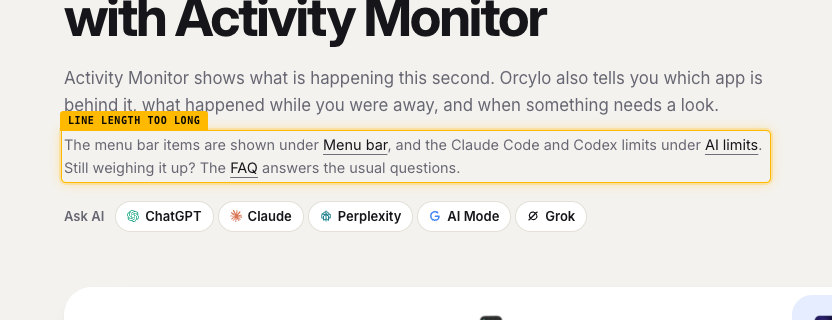
Line length too long · quality3×
Text lines wider than ~80 characters are hard to read. The eye loses its place tracking back to the start of the next line. Add a max-width (65ch to 75ch) to text containers.
Example: ~93 chars/line (aim for <80)
Positioned child clipped by overflow container · quality1×
A clipping container (overflow hidden or clip) wrapping an absolutely-positioned child cuts off tooltips, menus, and popovers that need to escape. Let the overflow be visible, or move the positioned layer out of the clip.
Example: div.mb-pane.mb-surface.tint-sound.p-3 clips a positioned child
Full annotated page (600 labels)

This report is complete and free, and true as of the scan time above. The next deploy, a tag added in Tag Manager or a redesigned footer can change it. Watch re-checks orcylo.app every day and after every deploy, emails you the moment something regresses, keeps the dated record, and gives you a trust page your customers can check.
Watch orcylo.appTrust page draftPassed audits
(10)
Privacy policy is present
A privacy policy link or page was found.
Privacy policy covers the expected disclosures
2147 words; 14 disclosure checks passed; last updated 3 October 2026.
No third-party trackers detected
None of the common analytics or marketing pixels were found in the page.
Terms of service are present
A terms page or link was found.
Public contact or business identity present
A contact email, contact page, or mailto link was found.
No secret keys in the page or its scripts
No server-side keys (Stripe secret, OpenAI, Anthropic, AWS, GitHub, Slack, SendGrid, Supabase service_role, private keys) in the page or the 6 script bundles it loads.
3 security headers set
Content-Security-Policy, X-Content-Type-Options, X-Frame-Options
No mixed content
All referenced resources use HTTPS.
Served over HTTPS
The final URL uses TLS.
30 accessibility rules passed
Rules axe-core tested and found no violations for.
Share this report.
The link is public and shows the same free view you see here; nothing about the reader is recorded.
The certificate.
orcylo.app holds Clean Bill of Health WO-2026-0905, last checked November 22, 2026. Open it for the seal and what it verified.
Put your score on your README.
An embeddable badge that re-checks weekly. Builders use it the way they use a CI badge: proof the boring stuff is handled.
[](https://webopsy.tech/s/orcylo.app)